
Left parties have strongly condemned the government's decision to impose charges on UPI payments exceeding Rs 2,000, with CPI General Secretary D Raja alleging the move was made under "US pressure" to favour foreign payment companies. Both CPI and All India Forward Bloc demand the withdrawal of this "anti-people decision," arguing it burdens consumers and merchants while undermining UPI's role as a public digital infrastructure. They highlight concerns that the charges weaken India's digital sovereignty and serve commercial interests of foreign corporations like Visa and Mastercard.

Sonia Gandhi criticised PM Modi's Israel visit, calling it a "bewildering strategic decision" amid the regional conflict.

Russian President Vladimir Putin asserted that any attempts to undermine India's sovereignty through 'threats of sanctions' would 'boomerang immediately' under Prime Minister Narendra Modi's leadership, highlighting India's sovereign decision-making and strong national interests.
The opposition has strongly criticised the government's decision to introduce a 0.4% Merchant Discount Rate (MDR) on UPI transactions above Rs 2,000 for merchants, effective October 15. They allege the move is a result of US pressure and will lead to increased commodity prices, calling it a "betrayal" of the common man. The government, however, clarifies that customers will not be charged, and the MDR applies only to merchants for larger transactions.

For India, the goal is not simply to host another grand diplomatic gathering. It is to prove that a diverse coalition of emerging powers can still deliver.

Notwithstanding the economic complementarities and the host of agreements for deepening economic relation on a host of areas, both sides share common viewpoints on the foreign policy domain and seek common grounds to serve as a counterweight to China, notes Dr Rajaram Panda.

India is deeply concerned by the growing consolidation of Pakistan-backed jihadi and radical Islamist groups in Bangladesh, particularly in the strategically vital Chittagong Hill Tracts, which experts warn is transforming the country into a new safe haven for these networks and posing a direct threat to India's security.

The Indian government has introduced a 0.4% fee on UPI transactions above Rs 2,000 for merchants, effective October 15, sparking strong opposition from political parties and traders. Despite accusations of foreign influence and demands for a rollback, the finance ministry and top functionaries have stated there will be no reversal, citing the need for a self-sustaining digital payments ecosystem.

In the first-ever separate resolution on foreign policy brought in its National Executive in Bengaluru, BJP attacked the previous Congress-led Government, saying "a cursory glance at the 'lost decade' of the UPA, reveals retreat and a loss of direction in engaging with neighbours, ham-handed diplomacy vis--vis Pakistan and a blind-spot in our foreign policy to the Indian Ocean island states."

Khan said that India, which is a part of Quad, has imported oil from Russia despite American sanctions.

'The Chinese military cannot advance much in Ladakh, even if they want to.' 'Similarly, in Arunachal Pradesh, they can rename a village or two, intrude here or there, but cannot do much more realistically.'
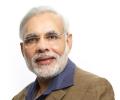
The major driver of Mod's foreign policy can be gauged from his economic priorities such as creating employment opportunities for the youth bulge. Related to this is emphasis on manufacturing, and infrastructure development, which in turn raises the issue of FDI. He has already articulated his views on all these issues, says Rup Narayan Das.
The opposition has intensified its criticism of the government's decision to impose a 0.4 per cent Merchant Discount Rate (MDR) on UPI transactions above Rs 2,000, effective October 15. Leaders like Rahul Gandhi and Jairam Ramesh allege the move is a result of US pressure, particularly from American card companies, and demand an immediate rollback, warning of increased costs for consumers.

The Congress party has accused the Indian government of imposing new charges on UPI transactions due to pressure from the United States, specifically to benefit American card companies. The opposition party demanded the withdrawal of the decision, calling it "anti-national" and alleging it fills the coffers of US firms while burdening Indian citizens. The government, however, clarified that the Merchant Discount Rate (MDR) charges apply only to commercial transactions above Rs 2,000 and are not levied on consumers, a stance supported by the BJP which accused Congress of spreading "fake news".
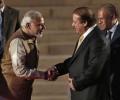
Prime Minister Narendra Modi's real test will be whether he can bring a longer-term vision to India's foreign policy planning, says Ravi Agrawal.

Few leaders since Independence have been able to establish such a direct connection with the electorate or shape the national conversation to the extent that Narendra Modi has done over the past decade, points out former Union minister Dr Karan Singh.

The Congress on Sunday lashed out at Prime Minister Narendra Modi over the US' statements after three Indian sailors were killed in American attacks on ships, with party leader Rahul Gandhi saying the "compromised PM" listens "like an obedient servant" and "complies with the orders".

Dinesh Trivedi's success or failure in this fragile diplomatic equilibrium will have consequences extending well beyond the Indian high commission in Dhaka. It will shape India's eastern strategic environment for years to come.
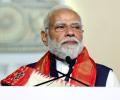
Congress leader Rahul Gandhi has criticised Prime Minister Narendra Modi's call for citizens to make economic sacrifices in response to the West Asia conflict, calling it 'evidence of failure'. Gandhi accused Modi of shifting responsibility onto the public and being incapable of running the country.

India and China are in what experts call 'a cooperation-versus-competition situation'.

'What gives hope is that Modi's own leadership is vitally linked to his capacity to deliver on the economic front. Indeed, if he succeeds, India's foreign policies will have changed beyond recognition,' feels Ambassador M K Bhadrakumar.

Congress leader Rahul Gandhi has warned of a severe economic crisis looming over India, criticising Prime Minister Narendra Modi's economic policies and foreign travels.

Bangladesh has once again sought the extradition of former premier Sheikh Hasina from India during High Commissioner Dinesh Trivedi's first meeting with Prime Minister Tarique Rahman in Dhaka, amidst fresh strains in ties between the two countries following Hasina's controversial virtual media interaction in New Delhi.

Dharmendra Pradhan's resignation is significant because it punctures, however slightly, the perception that the Modi government never retreats under pressure. Every long-serving government eventually reaches a point where every institutional failure is identified with the leader himself. Removing the minister may have prevented that political burden from falling directly on Modi. Whether it also resolves the underlying crisis is another matter, notes Ramesh Menon.

The Congress party has alleged that convicted sex offender Jeffrey Epstein played a role in shaping the India-Israel relationship after 2014, citing email exchanges made public under the 'Epstein Files'.

'The big power struggle in faraway Europe erupted at a most critical juncture when India has been increasingly sceptical about American policies and statesmanship,' argues Ambassador M K Bhadrakumar.

The rules require nuclear plant operators to maintain an insurance policy, financial security or a combination of both to cover civil liability for nuclear damage.

'You have to get private investment to somewhere between 35% to 36% of GDP. It is hovering about 30%-31%.'

AICC general secretary Sachin Pilot has accused Kerala Chief Minister Pinarayi Vijayan of following similar political approaches to Prime Minister Narendra Modi, alleging a tacit understanding between the CPI(M) and the BJP in Kerala.

The BRICS summit in New Delhi brings together leaders from major emerging economies to address global challenges like trade disputes, geopolitical upheavals, and the economic impact of conflicts in Ukraine and West Asia. India, as chair, aims to position BRICS as an economic growth engine, focusing on the Global South's food, energy, and supply chain security. The summit also highlights the grouping's expansion and its growing influence in global governance.
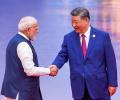
India's dual pursuit of a robust strategic partnership with Washington and a pragmatic, tension-management policy with Beijing represents the essence of modern multi-alignment. By embracing economic pragmatism, learning to compartmentalize political differences, and engaging in continuous dialogue, India can secure its borders, grow its economy, and contribute to a stable, multipolar Asian century, points out Ambassador Rajasekhar.

Insights from behavioural economics suggest that an ambitious nudge can be effective if three conditions are met, points out Ram Singh Insights from behavioural economics suggest that an ambitious nudge can be effective if three conditions are met, points out Ram Singh, director, Delhi School of Economics.

India is hosting the BRICS summit, leveraging the platform to address global trade tensions and champion the developmental priorities of the Global South, including food, energy, and supply chain security. The summit, attended by leaders like President Xi Jinping and Vladimir Putin, will focus on resilience, innovation, cooperation, and sustainability, with India aiming to strengthen intra-BRICS collaboration and discuss global matters. The expanded BRICS grouping represents a significant portion of the world's population and GDP, making its discussions crucial for global economic stability.
Following through announcements with enforcement of measures is key, as a run through recent Indian economic history shows, points out A K Bhattacharya.

Digital money is gradually starting to behave like software. It's no longer inert -- sitting passively in accounts. In the not-so-distant future, your money could become 'smart' and 'active,' understanding your preferences, paying your bills automatically, optimising your returns, and managing your risks -- all without you having to manage the details.

It is time the political leaderships in this country arrived at a common ground over issues of foreign and security policy concerns. There has to be a greater communication between the government and the Opposition leaderships for the nation to present a unified face against the rest of the world, advises N Sathiya Moorthy.

India's position appears to be anchored around three red lines: Hasina's safety and the guarantee of a fair trial; assurances that Bangladeshi territory will not be used for activities hostile to India; and the restoration of an inclusive democratic process in Bangladesh.

'Wages have not risen. Rural wages have stagnated. The growth was 0.7 per cent last year. For casual and irregular labour, the wage growth is negative.'

The government's foreign policy lacks coherence, clarity and consistency, they said.

It is plain to see that the US senate bill's real objective is to derail India's time-tested strategic partnership with Russia, points out Ambassador M K Bhadrakumar.
